Nigeria Probes Random Civilian Shooting
By Ahmed M Kamara ·
From the Newstime Africa archive. Originally published on 21 July 2009. By Ahmed M Kamara.
Random Shooting In Jos
Random Shooting In Jos
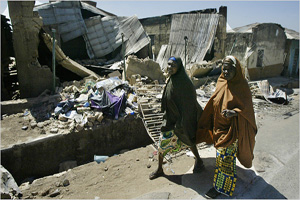
Testimony has been given to a judicial probe of sectarian violence last year in central Nigeria, urging authorities to prosecute soldiers and security police for allegedly killing 133 men and boys, almost all of them Muslims. The victims, from the city of Jos in Plateau State, were randomly gunned down under emergency shoot-on-sight orders from state Governor Jonah Jang between 28–29 November, 2008. The executions took place in the midst of riots between Muslim and Christian mobs that broke out during local elections. The clashes left more than 700 dead.
Researcher Eric Guttschuss testified yesterday before the Plateau State Judicial Commission of Inquiry on behalf of Human Rights Watch, which the government permitted to gather evidence between last November and February of this year. He says the devastation burdened all sides and responsibility for the killings needs to be addressed.
“There were devastating losses on all sides, loss of life, of churches and mosques that were burned and destroyed of religious leaders, of Christian pastors and church leaders who were killed during the violence. Our testimony, however, focused on the specific issue of allegations of killings by security forces,” he reported.
Human Rights Watch issued a report Monday, coinciding with Guttschuss’ testimony before the commission. It says policemen and soldiers gunned down unarmed citizens in their homes, lined up victims on the streets for summary executions, and hunted down unarmed men trying to flee to safety.
Guttschuss says although 131 of the 133 civilians were Muslims, Monday’s panel seemed eager to portray Human Rights Watch findings as biased in favor of the Muslim side.
“The commission expressed their concern and said that we were looking at killings where the victims were Hausa-Fulanis and not Christians. This is not the case, and we’ve made it very clear our testimony is focused on the narrow issue of the killings by security forces,” he explained.
Jos has seen a series of religious and election-related clashes that date back to 2001, when more than 1000 civilians died in mob violence. At issue in last November’s elections was the local post of chairman, which the ruling People’s Democratic Party (PDP) had won from majority Muslim All Nigerian Peoples Party (ANPP). Guttschuss says a lot was at stake in last year’s vote.
“Within Nigeria, certain ethnic groups within each local government area are classified as indigenes, those who can trace their ancestry to what are said to be the original inhabitants of that area. In Jos, the indigenes are primarily three Christian ethnic groups, whereas the Hausa-Fulani are classified as non-indigenes within Jos North. Local government elections could have determined which group gets its classification and thus gets access to jobs at the state and local governments, preferential treatment in terms of entrance into the university and scholarships. So there’s a lot at stake,” he noted.
The geographic location of Jos, which lies in Nigeria’s “middle belt” between a northern Muslim stronghold and the majority Christian south, has made it a flashpoint for periodic ethnic strife. Nevertheless, Nigerian Muslims and Christians generally have coexisted peacefully over the years.
Human Rights Watch’s Eric Guttschuss says that political and religious affiliations play a complicated, often unpredictable part in the Plateau State violence, and authorities have in the past been reluctant to assess responsibility and take meaningful action.
“This is not the first time a judicial commission of inquiry has been established in Jos. Following the 2001 elections, a judicial commission of inquiry was established. Unfortunately, the report was never made public and the findings of the report were never implemented by the government. We have called on this commission to ensure that their findings are made public. We also have called on them to investigate allegations that security forces were involved in the killings,” he said.
Plateau State Governor Jonah Jang is affiliated with the same PDP political party as Nigerian President Umaru Yar’Adua, a majority of Nigeria’s state governors, and authorities in charge of Nigeria’s federal government. But in the wake of last year’s sectarian violence and the arrest of 26 suspected mercenaries said to be linked to the disturbances, the Plateau State chief executive has become an isolated figure within his own party.
People who looked at this item also looked at…
- Maathai: Kenya Heading For Ecological Disaster
- Strike Over Presidential Decree In Niger
- Al-Shabab Bars 3 UN Agencies From Somalia
Related items
- Opposition In Ghana Accuses Government Of Persecution
- Oil Tanker Crew Released By Militants
- Charles Taylor Testifies: Prince Johnson Killed Doe
- Minister Gives 13 Reasons To Celebrate President Koroma's Leadership
- General Aziz Wins Mauritania Election
Original publication: https://web.archive.org/web/20090724005606/http://www.newstimeafrica.com:80/category/african-news/west-africa/feed/