Vladimir Putin Wants to Redraw Europe’s Security Map: Britain Must Stand Firm and Europe Must Stop Depending on America
By Ahmed M Kamara ·
By Ahmed M Kamara · 14 November 2026
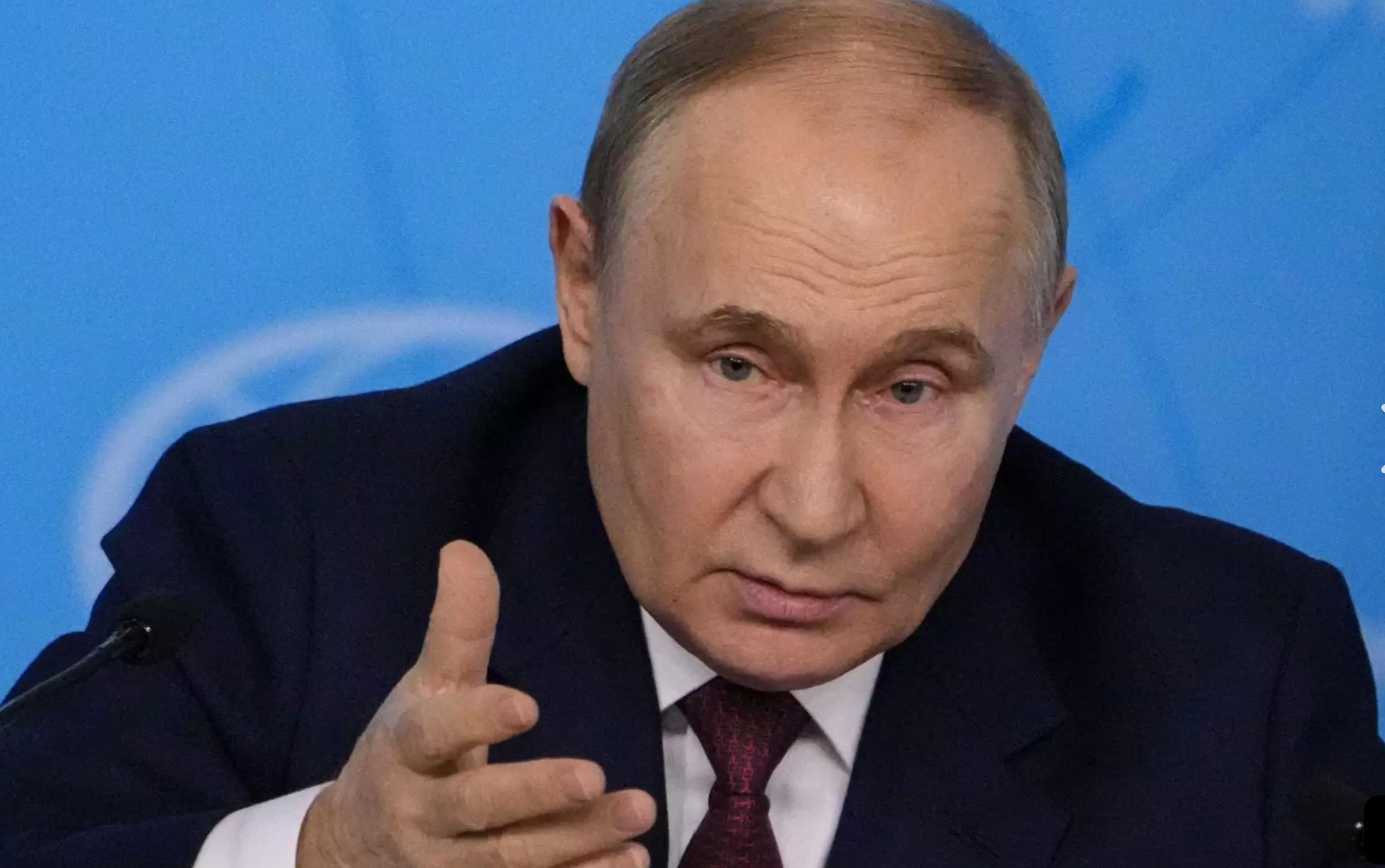
Vladimir Putin’s latest reported demands should send a powerful warning across Europe. Moscow is not simply seeking an end to the war in Ukraine. It appears to be pursuing something considerably more ambitious: a fundamental restructuring of Europe’s security arrangements, designed to weaken NATO, undermine Western influence and restore Russia’s ability to dominate the countries within its former sphere of influence.
Among the conditions reportedly put forward by Russian negotiators is a demand that Britain and France abandon their commitment to extending nuclear protection to other European countries. Moscow also wants NATO’s military presence in Eastern Europe rolled back to positions held in 1997, an end to Western military assistance to Ukraine and a permanent rejection of Ukraine’s ambition to join NATO.
These are not ordinary negotiating demands. They represent a direct challenge to the political and military foundations of European security.
Putin appears to be asking Western governments to accept a settlement that would not only restrict Ukraine’s future but also weaken the ability of other European nations to defend themselves.
The question European leaders must now confront is straightforward: why should Europe agree to a peace settlement that could make the continent less secure than it was before Russia invaded Ukraine?
Putin’s ambition goes far beyond Ukraine
For too long, some Western political leaders have treated Russia’s invasion of Ukraine as though it were simply a territorial dispute between two neighbouring countries. That interpretation fails to recognise the wider strategic implications of Putin’s actions.
Ukraine is central to Russia’s ambitions, but it is not necessarily the final destination.
Putin has repeatedly demonstrated his determination to restore Russian influence over countries that were once part of the Soviet sphere. His objections to NATO enlargement, his opposition to Western military support for Ukraine and his demands for restrictions on the alliance’s presence in Eastern Europe all point towards a broader objective.
He wants a Europe in which Russia has greater freedom to exercise political and military pressure over its neighbours.
The demand for NATO to return to its 1997 positions is particularly revealing. It would effectively require countries that joined the alliance after the Cold War to accept a dramatic reversal of their security arrangements.
For Poland, the Baltic states, Romania and other Eastern European countries, such a concession would raise deeply troubling questions about their independence and long-term protection.
These nations joined NATO because they wanted security, stability and protection against the possibility of renewed Russian aggression. Their security cannot simply become a bargaining chip in negotiations between Washington and Moscow.
European sovereignty must not be negotiated away to satisfy the ambitions of the Kremlin.
Britain’s nuclear deterrent is not Putin’s to negotiate
Perhaps the most alarming element of the reported Russian proposals is the demand that Britain and France abandon their nuclear protection of European allies.
Britain’s nuclear deterrent is one of the most important instruments of its national defence and its contribution to NATO. The Trident system exists to deter the most extreme threats against Britain and to contribute to the wider security of the alliance.
France also maintains an independent nuclear deterrent, giving Europe an important strategic capability of its own.
Putin’s apparent desire to weaken this arrangement should be understood for what it is: an attempt to reduce the strategic influence of two European powers and make other European nations more vulnerable to Russian pressure.
Britain must reject any suggestion that its nuclear policy should be determined by the demands of the Kremlin.
The decision over Britain’s nuclear deterrent belongs to the British government and the British people, not Vladimir Putin.
There is also a wider responsibility. Britain’s security is closely connected to the security of its European neighbours. A serious threat to Poland, Estonia, Latvia, Lithuania or another NATO member cannot be dismissed as somebody else’s problem.
Although nuclear deterrence is not a substitute for conventional military strength, it remains a fundamental part of NATO’s defence posture. Weakening that deterrent without credible alternative security arrangements would be strategically reckless.
Britain must therefore remain committed to NATO while working with France and other European partners to strengthen the continent’s ability to defend itself.
Europe can no longer afford to depend entirely on America
Perhaps the greatest lesson emerging from the Ukraine war is that Europe has become too comfortable relying on American military power.
For decades, European governments benefited from the American security umbrella while failing to invest sufficiently in their own defence capabilities. Many countries reduced military spending, neglected essential equipment and allowed their defence industries to become dependent on external suppliers.
That arrangement is now facing a serious test.
Donald Trump’s approach to NATO and the war in Ukraine has exposed uncomfortable questions about the reliability and consistency of American leadership.
His repeated demands that European allies increase defence spending have created tensions within the alliance. His approach to negotiations with Moscow has also generated concern among European governments that fear Ukraine could be pressured into accepting an unfavourable settlement.
Whether or not America ultimately maintains its traditional commitments, Europe must prepare for a future in which Washington may be less willing to shoulder the continent’s security responsibilities.
This is not an argument for abandoning the United States or weakening NATO. On the contrary, a stronger Europe would make NATO more credible and the transatlantic partnership more balanced.
Europe must develop the military capabilities, industrial capacity and political determination necessary to defend itself.
It needs stronger armed forces, greater ammunition production, modern air defence systems, improved intelligence capabilities and more effective coordination between national militaries.
Most importantly, European governments must demonstrate that their commitment to collective security is not dependent entirely on the political mood of the White House.
A continent of Europe’s economic strength and population should not find itself strategically helpless whenever Washington changes its foreign policy priorities.
Ukraine must not become the victim of another great-power bargain
There is another fundamental issue that cannot be ignored: Ukraine’s right to determine its own future.
The Ukrainian people have endured enormous suffering since Russia launched its full-scale invasion in February 2022. Thousands have lost their lives, millions have been displaced and vast areas of the country have suffered destruction.
Any genuine peace agreement must recognise Ukraine’s sovereignty and provide credible protection against future aggression.
It would be deeply troubling if Ukraine were pressured into accepting territorial losses, abandoning its security ambitions and surrendering the ability to defend itself simply because powerful countries want to reach an agreement with Moscow.
Ukraine is not a piece of property that can be exchanged between world leaders.
Nor should its future be determined without meaningful Ukrainian participation.
Russia’s willingness to accept possible Ukrainian membership of the European Union, while insisting that Kyiv remain outside NATO’s defence arrangements, should also be examined carefully. Economic integration alone cannot guarantee national security.
A country can be economically connected to Europe while remaining dangerously exposed to military threats.
Any settlement must therefore include enforceable security arrangements, not vague promises that could collapse when the next crisis emerges.
Europe must rediscover its political courage
The danger facing Europe is not simply Russian military aggression. It is also the possibility that European governments become so divided, uncertain and dependent on external leadership that they lose the ability to defend their common interests.
Putin understands the value of political division. He knows that disagreements between Washington and European capitals can weaken NATO’s collective position.
He also understands that uncertainty can be a powerful instrument of foreign policy. If European countries begin questioning whether their allies will stand beside them during a crisis, the deterrent value of the alliance is weakened.
This is precisely why European unity matters.
Britain, France, Germany, Poland and the Baltic states must work together to develop a coherent security strategy. They may have different political priorities, economic interests and historical experiences, but they share a fundamental interest in preserving European sovereignty and preventing military intimidation from becoming an accepted instrument of international relations.
Britain has a particularly important role to play.
Despite leaving the European Union, the United Kingdom remains a major European military power, a permanent member of the United Nations Security Council and one of NATO’s leading members. Brexit did not remove Britain’s geographical position or its responsibility to contribute to the security of the continent.
London must therefore resist the temptation to treat European defence as a problem for Brussels alone. Britain’s security and Europe’s security are inseparable.
Peace must not become a Russian strategic victory
Nobody should underestimate the importance of ending the war in Ukraine. Peace would save lives, reduce suffering and provide an opportunity for reconstruction.
But peace at any price is not necessarily a lasting peace.
If Russia succeeds in forcing Ukraine to abandon its security ambitions, compelling Western governments to withdraw military support and persuading Britain and France to weaken their nuclear commitments, Putin could emerge from the negotiations having achieved major strategic objectives without securing everything he sought on the battlefield.
That would send a dangerous message to the rest of the world: that military aggression can ultimately deliver political concessions if the aggressor is sufficiently persistent.
It could also encourage other authoritarian governments to conclude that international borders, national sovereignty and collective security arrangements can be challenged through force and intimidation.
Europe must not reward aggression by dismantling the very arrangements designed to prevent it.
The objective should be a peace that protects Ukraine, preserves NATO’s credibility and strengthens Europe’s long-term security.
The choice facing Britain and Europe
Putin’s reported demands present Britain and its European partners with a defining moment.
They can either respond with strategic unity, stronger defence capabilities and a clear commitment to collective security, or allow political uncertainty and diplomatic pressure to weaken the foundations of European stability.
Britain must make it clear that its nuclear deterrent is not a bargaining instrument for the Kremlin. France must maintain its independent strategic capability. European governments must increase their defence cooperation and invest in the military strength required to protect their populations.
America remains an important ally, but Europe must no longer assume that American political leadership will always provide the answer to every security challenge.
The continent must be capable of defending its interests even when Washington’s priorities change.
Ultimately, Putin’s demands should be understood as a test of European political courage. The question is whether Europe’s leaders have the determination to defend the principles of sovereignty, independence and collective security, even when doing so comes with economic and political costs.
The future of Europe cannot be determined in the Kremlin, nor should it be decided exclusively in Washington.
It must be shaped by the sovereign nations and peoples of Europe themselves
© 2026, Ahmed M Kamara. All rights reserved. – The views expressed here are purely those of the author and not necessarily those of the publishers. – Newstime Africa content cannot be reproduced in any form – electronic or print – without prior consent of the Publishers. Copyright infringement will be pursued and perpetrators prosecuted.